

Aloha,
In July I wrote that Bill 88 was a framework rather than a rezoning. That was the right way to read it then.
It has started moving.
The first Council-initiated zoning resolutions are now in front of the Maui Planning Commission, a second set is being amended in committee, and three dates this month determine how quickly properties get through the pathway that Ordinance 6008 created.
If you own in an apartment zoned building in West or South Maui, this is the part where the abstract becomes a calendar.
A correction to what I wrote in July
Before the update, a fix.
In the July article I gave December 15, 2025 as the date Bill 88 was signed. That date belongs to Bill 9, which became Ordinance 5909. Bill 88 passed Council in June 2026 and became Ordinance 6008 effective June 22, 2026.
Two bills, two ordinances, six months apart, and I ran them together. The correction is going into the July article as well.
I would rather flag my own error than have you find it, and on legislation moving this fast the dates are the part that has to be right.
The three dates
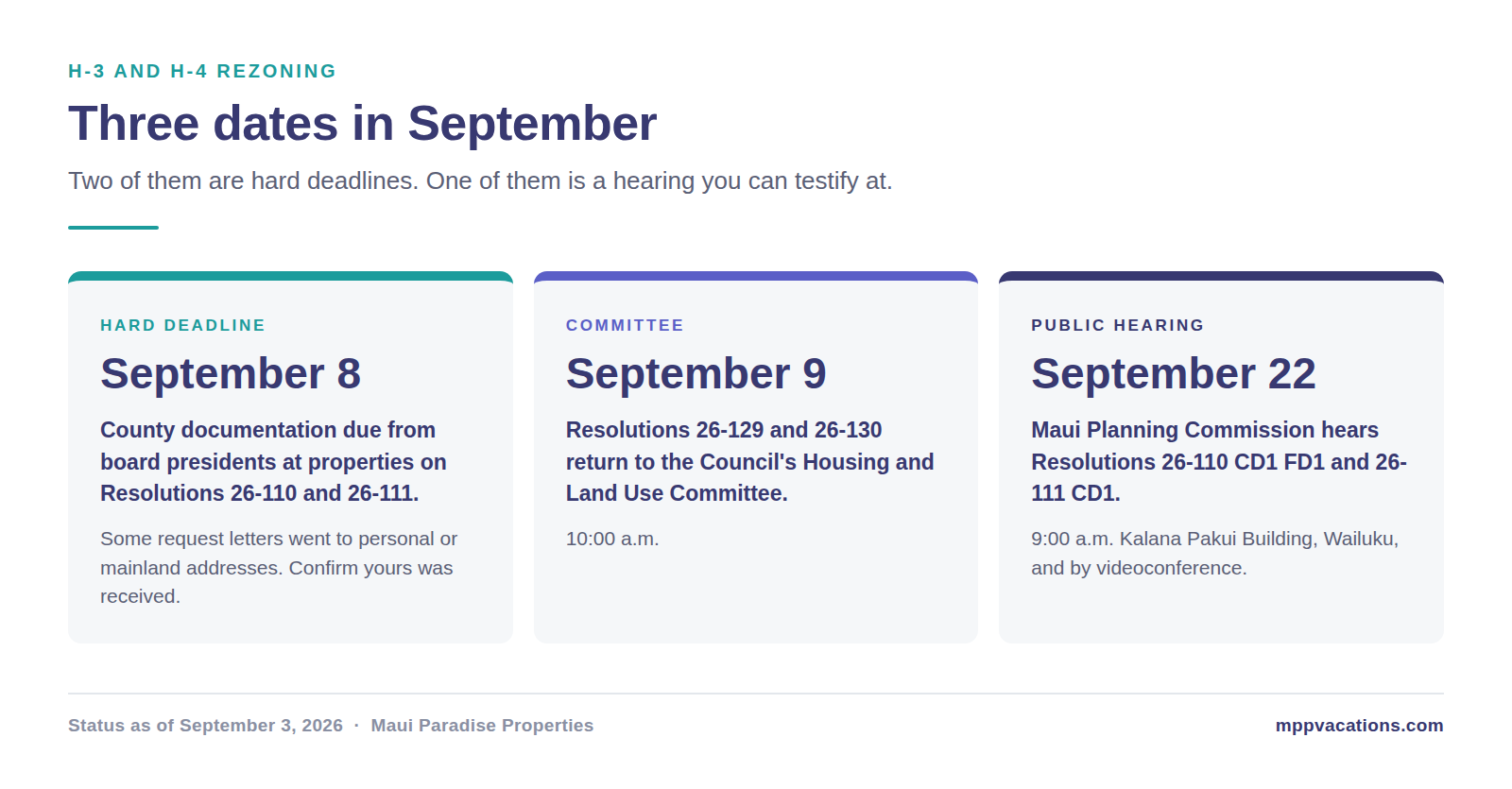
Three dates in September. Two of them are hard deadlines, and one of them is a hearing you can testify at.
September 8. County documentation is due from board presidents at properties on Resolutions 26-110 and 26-111. The County mailed requests asking for metes and bounds, community plan information, and documents supporting the proposed zoning change.
Watch this one. At least some of those letters went to board presidents at their personal mailing addresses rather than to the association or the management company. If your board president travels, or the letter went to a mainland address, it may be sitting unopened right now.
September 9 at 10:00 a.m. Resolutions 26-129 and 26-130 return to the Housing and Land Use Committee.
September 22 at 9:00 a.m. The Maui Planning Commission hears Resolutions 26-110 CD1 FD1 and 26-111 CD1, under case numbers ZPA2026-00003 and ZPA2026-00004. That is at the Planning Department Conference Room in the Kalana Pakui Building at 250 South High Street in Wailuku, and by videoconference. It was originally anticipated for September 8 and moved.
What Ordinance 6008 actually did
Bill 88 became Ordinance 6008, effective June 22, 2026. It created two new zoning districts, H-3 and H-4, and it established the legal pathway for a visitor accommodation property to move into one of them.
It did not rezone a single property.
Rezoning happens through separate Council-initiated resolutions, each of which goes to the Planning Commission for a recommendation and then back to Council for votes. That is the process now underway.
The reason it matters on a deadline is Bill 9, now Ordinance 5909, which set the phase out of transient vacation rental use in apartment districts for January 1, 2029 in West Maui and January 1, 2031 in South Maui and the rest of the county. A property that completes a zoning transition before its date is not caught by it.
That is the entire race.
What is on the current resolutions
Resolutions 26-110 and 26-111 together cover roughly 2,056 units across about fifteen named properties. They are the ones at Planning Commission this month.
Read the criteria carefully, because the most common misunderstanding I hear concerns 26-110. It reaches properties with a timeshare component. Most of the properties caught by it are predominantly fee simple condominiums that happen to contain some timeshare units. If you own fee simple in one of those buildings, your ownership does not change and your building being on that resolution is good news rather than bad.
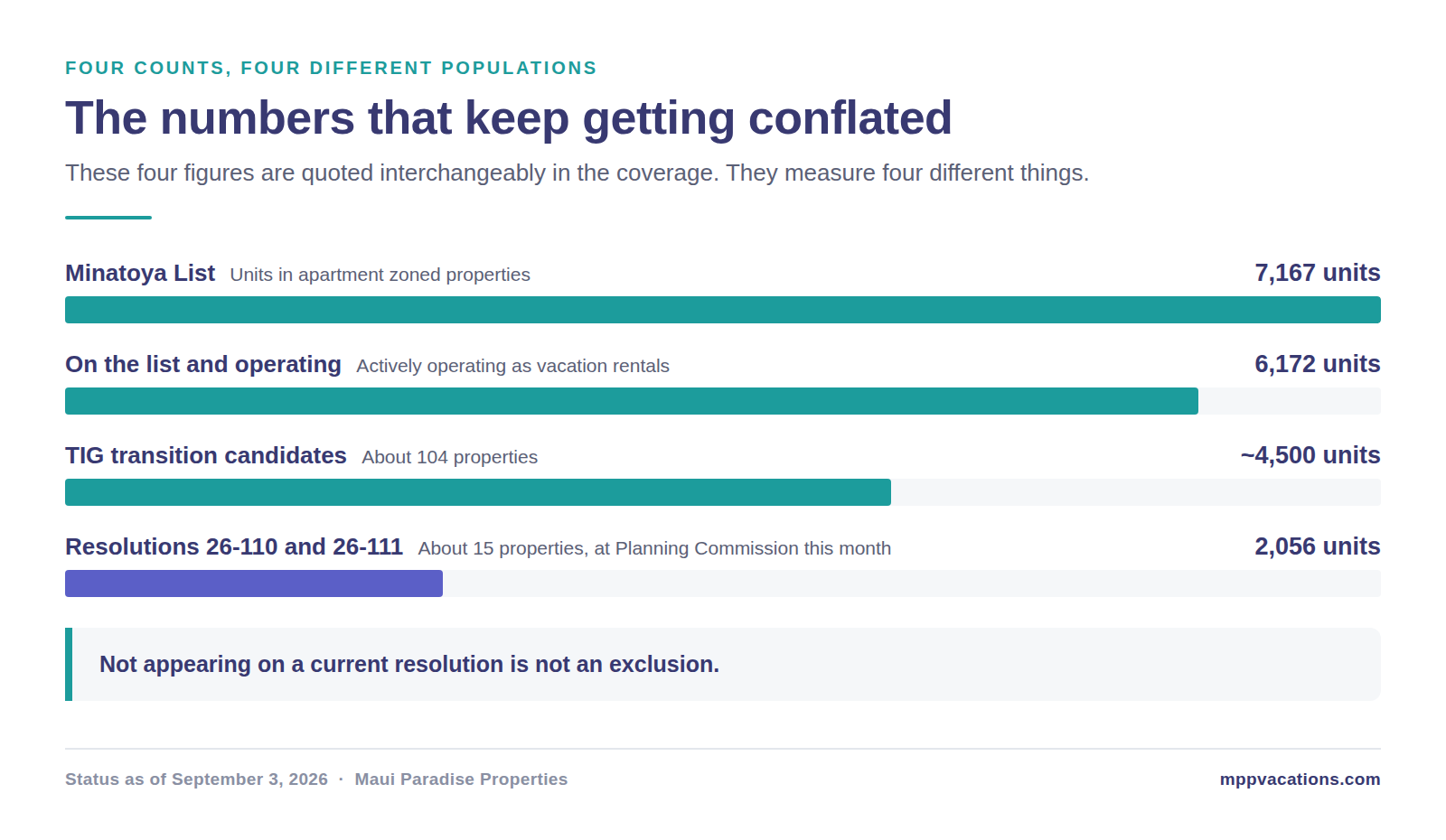
Four different counts, four different things being counted. Conflating them is the most common error in the coverage of this issue.
Four unit counts get quoted interchangeably in this debate and they measure four different populations:
- The Minatoya List covers roughly 7,167 units in apartment zoned properties
- Roughly 6,172 of those are both on the list and actively operating as vacation rentals
- The Temporary Investigative Group identified roughly 4,500 units across about 104 properties as transition candidates
- Resolutions 26-110 and 26-111 cover roughly 2,056 units across about fifteen properties
If your property is not on a current resolution, that is not an exclusion.
What changed on August 27
The Cook amendment rewrote the qualifying test on Resolutions 26-129 and 26-130. The indexed Legistar record confirms the committee took up the amended versions of both resolutions that day. It does not expose the roll call, so I am leaving the margin out.
It changed the qualifying standard from fully impacted to majority impacted, meaning 51 percent or more. It added two qualifying pathways, the Special Flood Hazard Zone and being subject to Maui Planning Commission shoreline regulations. And it added a condition that the property was not originally intended for affordable or workforce housing.
That 51 percent threshold applies only to 26-129 and 26-130. Each resolution carries its own criteria, and the timeshare, leasehold and hotel operation resolutions are unaffected by it.
How to check your own building’s exposure
The amendment made flood and shoreline status a qualifying pathway, which turns a map lookup into something directly useful.
For scale on how many buildings this could reach: in a mapping review, the Planning Department identified some degree of exposure at structures within 43 Minatoya List properties containing 2,440 total units. Exposure ranged from very minimal to full, and the Department said determining how many individual units actually sit inside the area would require detailed site analysis. So 2,440 is the unit count at those 43 properties. It is not a count of units sitting inside the exposure area.
You can look up your own building rather than waiting to be told. Three official tools do it:
The State of Hawaiʻi Sea Level Rise Viewer shows the 3.2 foot Sea Level Rise Exposure Area directly, with parcel boundaries so you can find your property, plus overlays for FEMA flood zones and coastal erosion.
The Maui County Flood Hazard Zones page has the County flood zone viewer and links to the FEMA National Flood Hazard Layer, searchable by address.
The State Flood Hazard Assessment Tool searches by address or TMK, which is usually the fastest way to get a clean answer for a specific parcel.
One thing worth knowing while you are in there. Hawaiʻi law requires a seller’s disclosure statement to identify residential real property within the officially designated Sea Level Rise Exposure Area, subject to the statute’s mapping provisions. That obligation exists independently of anything happening in these resolutions.
Nothing is final. Still open when the committee reconvenes on September 9: a possible 2008 residential and owner occupancy criterion, potential conditions of zoning including engineering assessments, shoreline mitigation, insurance and reserves, and shoreline access, and how the overlapping map areas get applied property by property.
What the Planning Commission will and will not do
The Commission makes a recommendation. It does not make the final decision.
What it recommends changes the arithmetic at Council. If the Commission recommends approval and Council acts consistently with that, the ordinary voting requirement applies. If the Commission recommends denial, recommends a modification Council does not accept, or does not report within the applicable deadline, passage generally requires six Council votes.
Six is a meaningfully harder number than five. That is why the September 22 hearing matters more than its agenda position suggests.
Why the Council initiated route is the one we are pushing
Three pathways to rezoning exist, and all three exist only because Ordinance 6008 created the districts.
Council initiated changes are what is happening now. Council moves groups of properties through together and works to a defined schedule.
Administration initiated changes run the same mechanism with the Administration driving rather than Council.
Owner initiated changes mean an individual association applies on its own.
MVRA and HIMAST have both supported the Council initiated route for practical reasons. Properties move together, which reduces duplicated application work and can lower the administrative burden carried by any single association. Going it alone means one complex bearing the entire process by itself.
If your complex ends up needing to go it alone, that door is open. It is simply slower and considerably more expensive, and any association considering it should price the process honestly before committing to it.
Every association is different
There is no universal strategy here, and I want to say that plainly because a lot of what circulates gets passed around as though it applies to everyone.
Every association has its own governing documents, ownership structure, historical use patterns, legal considerations and supporting evidence. What is obviously right for one complex can be wrong for the building next door.
Organize, identify your representatives, and work through your own board and advisors on what fits your circumstances. Do not run your complex’s strategy off what another complex is doing.
The affordability round is coming
Some properties identified in the TIG materials are not included in a current resolution. The next round is anticipated to turn primarily on affordability.
No public introduction date or final criteria have been established. I am not going to speculate on timing.
If affordability might apply to your complex, start now rather than when the resolution drops.
What to assemble if affordability may apply
The goal is a complete and documented picture of what it actually costs to own and maintain a unit in your building.
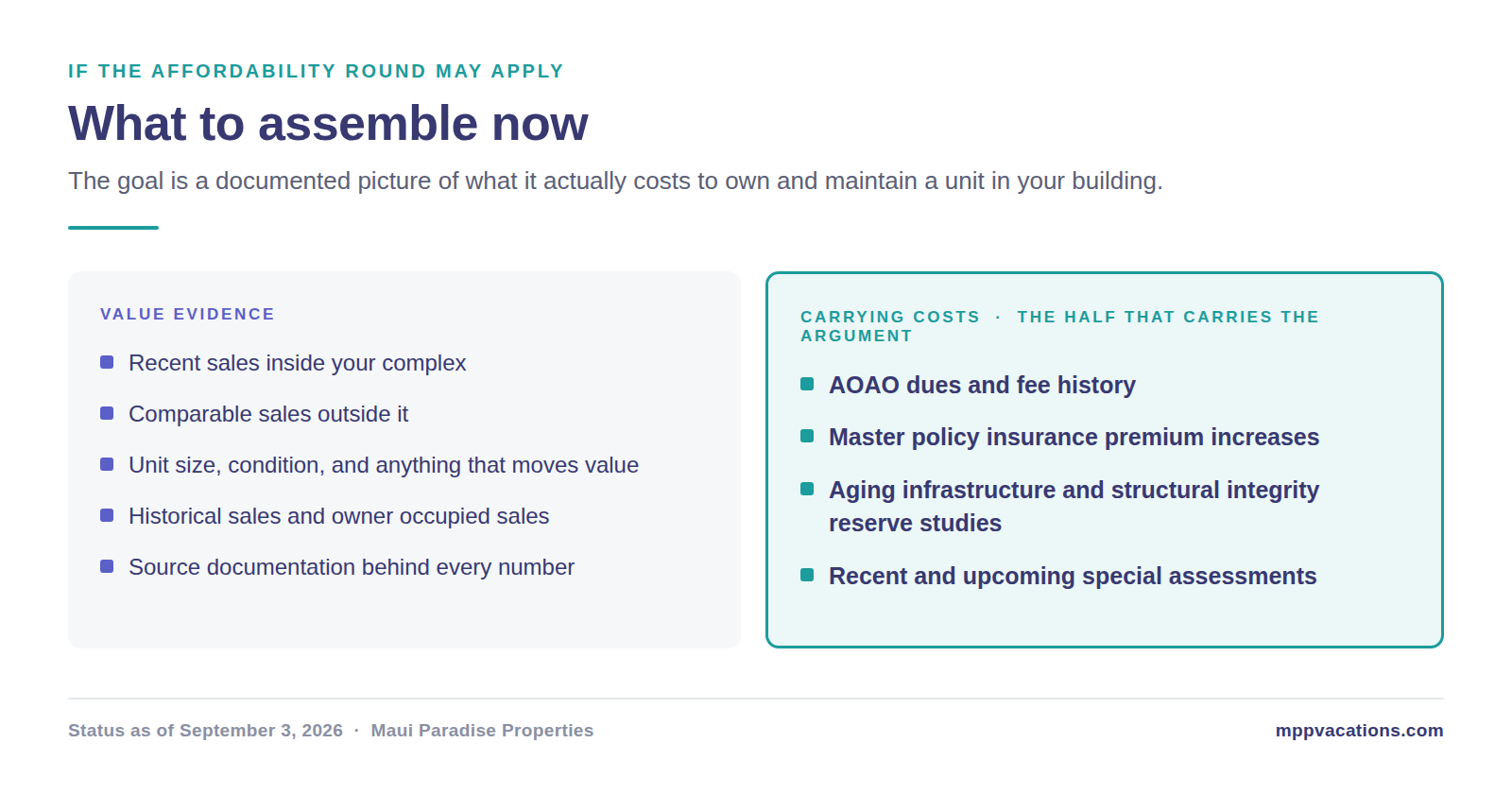
Print this and work it as a checklist. The right hand column is the half that carries the argument.
Pull recent sales inside your complex. Pull comparable sales. Identify unit size, condition and anything else that moves value. Gather historical sales information and owner occupied sales where relevant. Keep the documentation underneath every number.
Then document the carrying costs, because this is the part owners consistently underweight:
AOAO dues and fee history. Master policy insurance premium increases. Aging infrastructure and structural integrity reserve studies. Recent and upcoming special assessments.
If you are an MPP owner, we have most of this on file already and I would rather pull it for you than have you rebuild it from scratch. Ask your owner manager and it gets assembled.
What the UHERO data actually shows
Since I am citing the study, here is what is in it rather than only the number that helps my argument.
UHERO looked at the Minatoya List against Maui’s housing stock. Maui has about 63,000 housing units, roughly 47,400 in long term supply and about 13,000 operating as vacation rentals. The Minatoya List is 47 percent of the vacation rental total.
The strongest finding for the other side. Converting these units would increase Maui’s long term residential housing stock by about 13 percent. That is a real number and it is the best argument the policy has. Anyone on my side of this who pretends otherwise is not arguing in good faith.
The second one people quote at us. 85 percent of these units are owned by out of state residents, 36 percent in California, 12 percent in Washington, 8 percent in Canada.
I am not going to pretend that number does not exist. I will say what it does and does not tell you. Where an owner lives says nothing about whether the unit works as long term housing, and that second question is the one actually in front of the Planning Commission.
Which brings us to the part of the study that gets quoted least. The unit profile:
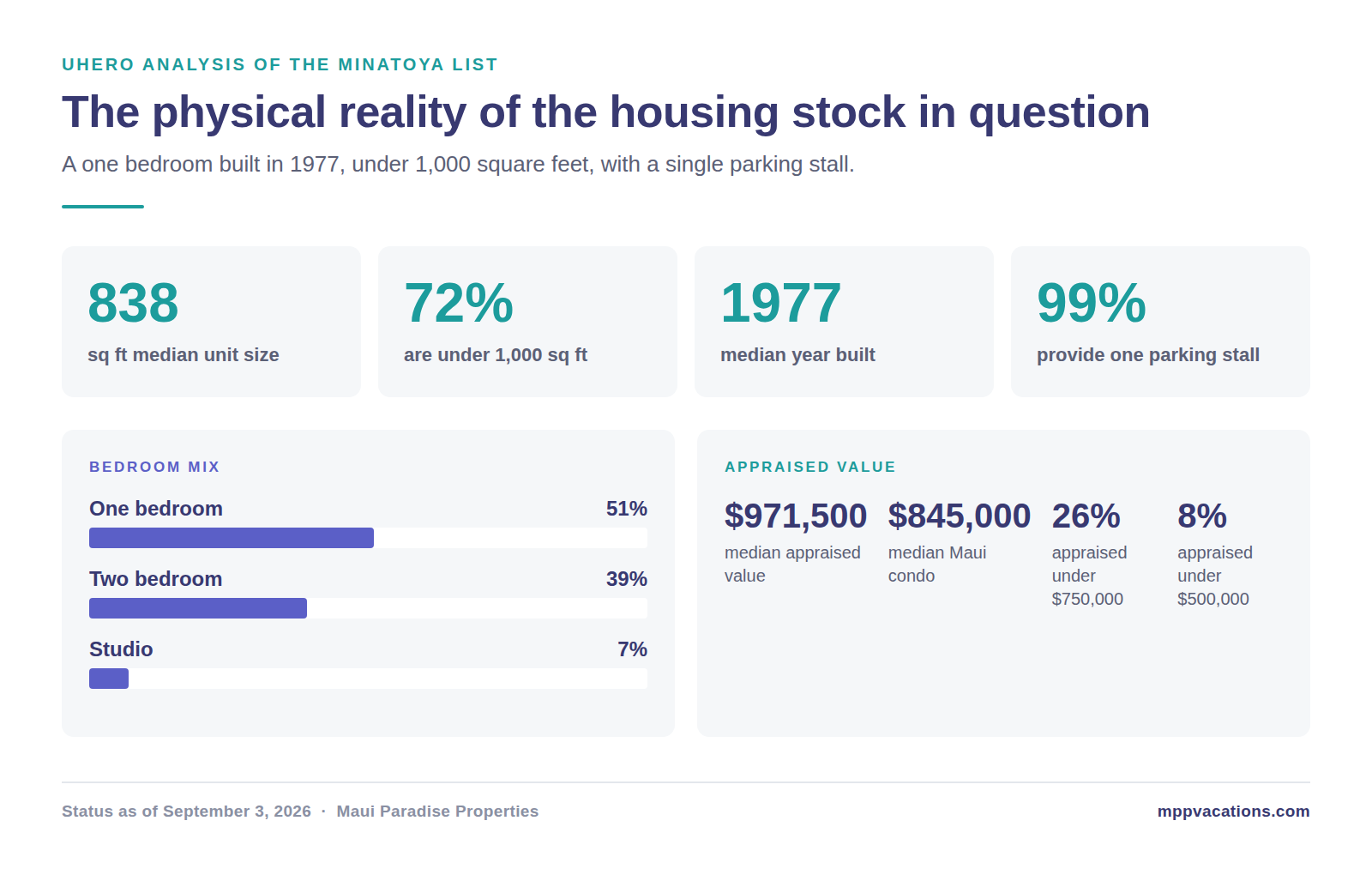
The physical reality of the housing stock in question, from the UHERO analysis. A 1977 one bedroom under 1,000 square feet with one parking stall.
Median size is 838 square feet, and 72 percent of these units are under 1,000 square feet. Fifty one percent are one bedroom, 39 percent are two bedroom, 7 percent are studios. Median construction year is 1977. Ninety nine percent provide a single parking stall.
Read that back as a housing proposition. A one bedroom built in 1977, under 1,000 square feet, with one parking stall, in a building carrying resort era infrastructure and the reserve obligations that come with it.
On value, the study puts the median appraised value at $971,500, about 15 percent above the median Maui condo at $845,000. It also found that 26 percent are appraised under $750,000 and 8 percent under $500,000.
That last pair of numbers is the honest version of the affordability conversation, and it points in both directions at once. Most of these units are not cheap. A meaningful share of them are not out of reach either.
The second UHERO study, on the economic side
There are two analyses and people conflate them. The one above is about housing supply. A separate UHERO analysis looked at economic impact and projected roughly 1,900 job losses, a decline in visitor spending on the order of $900 million, and county tax revenue effects in the tens of millions annually. It also noted that vacation rentals make up more than 20 percent of the countywide housing stock, about 50 percent in South Maui and 34 percent in West Maui.
Mayor Bissen responded publicly to that analysis. He called it a valuable first step and argued that economic models cannot capture residents’ lived experience or the cost of cultural displacement, that short term economic impacts do not reflect long term gains in restoring housing for residents, that tax revenue losses would arrive gradually enough to plan around, and that displaced jobs could shift into other sectors.
I am giving you his rebuttal in his own framing rather than mine. You can decide what you think of it. What you should not do is quote the UHERO economic numbers at a hearing without knowing the Mayor has already answered them, because someone in that room will.
I am citing all of this rather than the convenient half because the credibility of everything else in this article depends on it, and because an owner who quotes a study to a council member had better have read the whole thing.
Tell the story, do not draw the conclusion
This is where I want to be direct, because I watch it go wrong at nearly every hearing.
“Locals cannot afford these units” is the line I hear most often and the one I would retire first.
Start with the fact that it may not even be true. Local families own in these buildings. Some of the owners sitting in those hearings and submitting testimony are kamaʻāina. Saying it flatly tells a room full of residents what they can and cannot afford, which is not ours to decide and lands exactly the way you would expect it to.
It is also callous, and people hear it that way whether or not it was meant that way.
And on top of all that it is a conclusion rather than a fact, so it hands the other side an argument instead of building yours.
The alternative is to put the arithmetic on the record and let them do the math themselves. A unit sells for a certain number. Ownership also carries a monthly AOAO figure, annual property taxes, insurance, and a known or anticipated assessment. State those four things accurately for your building and stop.
An owner at Lahaina Roads did exactly this. He testified that he paid $240,000 for a 600 square foot one bedroom, and that his all in carrying cost runs $4,900 a month. He never once said the word affordability. He did not have to.
Your job is to document the financial reality of ownership. Defining affordability for somebody else is not your job.
Five rules for testimony that works
Know which resolution you are on. Know the criteria in that resolution. Know your facts. Have your documentation. Coordinate with the other owners in your building.
Keep it concise and stick to the criteria on the table. Speak specifically about your property. Do not re-argue Bill 9 at every hearing, and do not introduce issues that are not in front of the committee that day. Whether your building acts like a hotel is not relevant during 26-129 and 26-130.
And please coordinate. If five owners from your complex testify with the same three points, you have used up an hour and added one point to the record.
Back in June the argument was that effective, coordinated testimony matters more than volume. Four hearings into sea level rise exposure, that has held up.
November matters more than people think
This process runs into the next Council term. The decisions that follow these resolutions, on vacation rentals, property rights, taxation and the visitor economy, land on whoever is seated in January.
Be an informed voter. These are the organizations I would follow between now and November:
Maui Nui Empowered works on housing affordability, jobs and community engagement in Maui County, and is active in the conversations that shape this policy.
The Maui Chamber of Commerce tracks legislative priorities on the business and economic side and hosts candidate events.
RPAC is where the Realtor side of property rights advocacy runs, and I sit on the Realtors Association of Maui Government Affairs Committee.
Watch the candidate forums and questionnaires as they come out, and read the election coverage. Civil Beat does a thorough job on Maui races whatever you make of the rest of it.
Registration, deadlines and your ballot status all live at elections.hawaii.gov.
If you are not a voter here, you can still donate, volunteer, sign wave and stay informed.
Join HIMAST and MVRA
I am going to ask you directly, because this is one of the most useful things most owners reading this can do.
HIMAST, the Hawaiʻi Mid and Short Term Rental Alliance, runs on a small compensated staff and an all volunteer board. Caitlin Miller and Kelly Lee are both compensated. Every board member, me included, serves without pay.
That is what your money buys. The legislative analysis, the community updates, the testimony coordination and the education work are somebody’s job, and donations and membership are what fund those roles. There is no staff of twenty behind this.
I want to name Caitlin Miller specifically. As the former Executive Director of the Maui Vacation Rental Association and now the Executive Director of HIMAST, she has done more work in this education and advocacy space over the last couple of years than anyone. She has had strong participation from both boards and she would tell you that herself, and she has still carried more of it than any other person on this island.
MVRA, the Maui Vacation Rental Association, runs a membership program that funds the same fight at the county level, and members get the meeting updates, the regulatory news and the resources as they come out rather than months later.
Set the dues against what you are already spending. If you own a unit in one of these buildings, your AOAO dues alone run in the hundreds every month, and your position in this process is being defended by two organizations funded by a fraction of the owners who benefit from the work.
I am the board president of one of them and the former board president of the other, so of course I am going to say this. It is still true. Join both.
Who is actually doing this work
I want to name something, because it is relevant to who you take advice from.
Maui Paradise Properties has been, by a wide margin, the most active property management company on this island in the legislative effort around vacation rentals. Not the loudest. The most active, measured in hours in County chambers and testimony filed and owners educated.
John Kevan, our CEO, sits on the Right to Rent advocacy group and serves alongside me on the government affairs committee. He has been in these rooms consistently, on his own time, for a policy fight that carries no marketing payoff.
That matters for a practical reason beyond the civic one. MPP employs dozens of local people on Maui. Housekeepers, maintenance technicians, guest services, accounting, onboarding. Those are the jobs that disappear if the vacation rental inventory on this island contracts sharply, and they are the jobs nobody testifies about because the people holding them are working during the hearings.
I serve as President of the Board of HIMAST and I am the former President of the Board of the Maui Vacation Rental Association. I am also an owner and partner in Maui Paradise Properties, so read all of that as disclosed.
The reason I put it in front of you is not credentialing. It is that when I tell you what is happening at the County, I am telling you what I watched happen.
Zoning is the first problem, operations is the second
Here is where I want to be direct about something the legal coverage of this issue keeps missing.
Zoning determines whether your property can operate. It does not determine whether your property performs. Those are two different problems and they arrive in that order.
A building that clears the pathway into H-3 or H-4 still has to earn. In a market carrying more than 24 months of standing inventory in the luxury tier, with days on market up in every complex I track, the properties holding value are the ones being run well. Dynamic pricing rather than owner set rate floors. Interior condition maintained to the standard of the building rather than allowed to drift below it. Owner use scheduled deliberately rather than blocked out of habit.
I compared three residences in the same South Maui luxury complex this year. Same manager, same beach, same guest pool. Two of them ran roughly 73 percent occupancy. The third ran 55.9 percent and booked $64,000 less than one that sleeps the same number of people. The rates were within four percent of each other. The entire gap was occupancy, and two of its three causes were fixable decisions rather than structural facts.
That is what our management side exists to fix, and I wrote up how it works in how Maui Paradise Properties delivers operational excellence at scale. If occupancy is the number you have been chasing, why more bookings is not the goal is the argument against that.
And if the honest answer is that your current manager is not the one to fix it, what to know before changing property managers covers how that transition actually works.
So the honest sequencing for an owner right now is: get the zoning question answered, then get the operating question answered. Neither one substitutes for the other, and most owners are only working on one of them.
If you are buying or selling one of these properties
This is the part where the zoning question stops being civic and starts being financial.
Whether a building is on a resolution, which resolution, and how solid its position is under the current criteria can materially affect marketability, buyer risk tolerance, financing assumptions and value. I am underwriting that difference for clients right now on both sides of the trade, and MPP works both sides too. We manage them and we help owners buy and sell them.
In the transactions and buyer conversations I am seeing, properties carrying greater zoning certainty are beginning to separate from properties carrying more unresolved risk. I expect that spread to narrow as this resolves in one direction or the other, though I am telling you that as a read rather than a fact.
There is one piece of objective market mechanics worth knowing before you decide on timing. UHERO found a threshold effect in Maui condo pricing. In periods when available condo inventory sat below roughly 1,000 units, average annual appreciation ran near 10 percent. In periods when inventory rose above that level, average appreciation ran near negative 9 percent. For reference, available condo inventory was around 500 units in April 2024.
Draw your own conclusion about what happens to that threshold if a meaningful share of roughly 6,000 units reaches the market on a deadline. I will flag plainly that this is my speculation and not something the study projects. It is also the single best reason I know to treat the timing question as an analysis rather than a gut call. The wider version of that analysis, covering policy, tourism and where this market sits, is in Maui real estate in transition.
Send me the name of your complex. I will tell you whether it appears on a current resolution, which category it falls under, what the criteria mean for it, and how comparable properties have been pricing.
What we know, and what we still do not
Most of the confusion in this process comes from someone treating an open question as though it were settled. So here is the honest split.
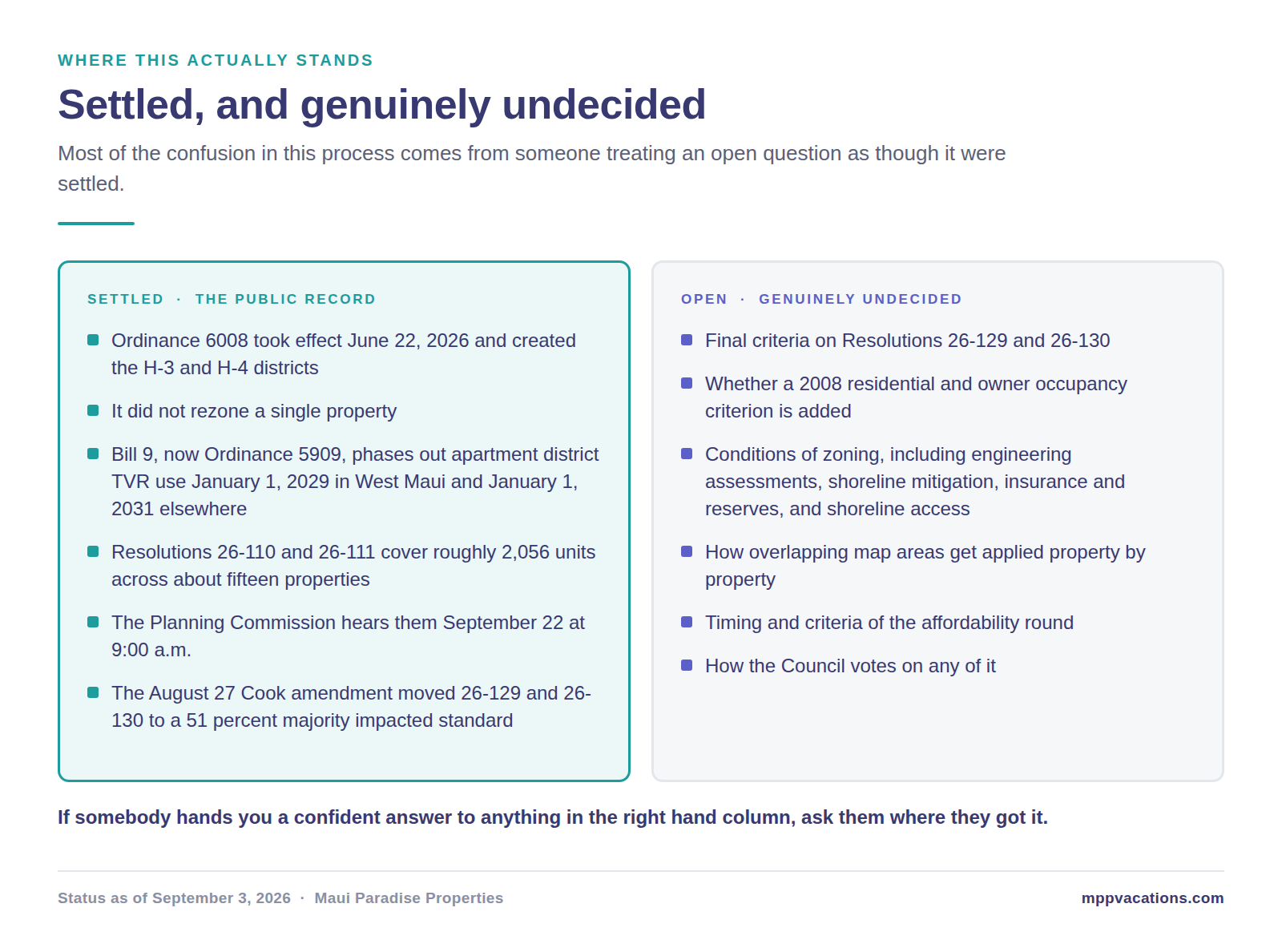
The left column is the public record. The right column is genuinely undecided, and anyone telling you otherwise is guessing.
If somebody hands you a confident answer to anything in that right hand column, ask them where they got it.
What to do this month
If your property is on 26-110 or 26-111. Confirm your board president actually received the County’s documentation request and that a response is going in by September 8. Check the mailing address it went to.
If your property is on 26-129 or 26-130. Understand the new 51 percent standard and which of the qualifying pathways your property might meet. Run the three map tools above on your parcel.
If your property is on nothing yet. Start assembling the affordability documentation now rather than when the next round is introduced.
If you plan to testify on September 22. Tell the Commission what is true about your property and your ohana. Do not draw the legal conclusion for them, and do not read someone else’s script.
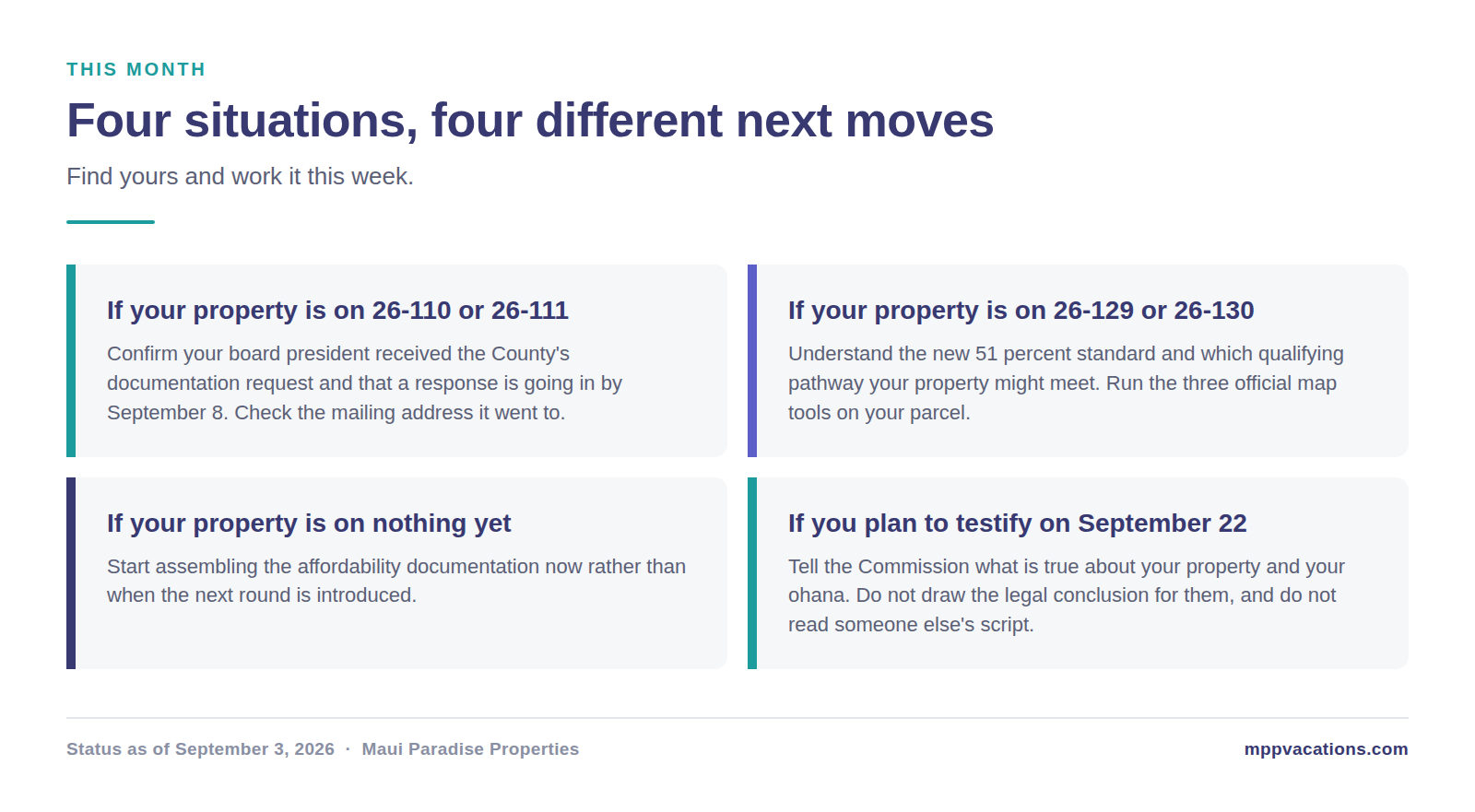
Four situations, four different next moves. Find yours and work it this week.
Where this leaves you
This is going to resolve in one direction or the other over the next several months.
If you want to know where your specific complex sits, send me the name of it. If the operating side is the part you have been worried about, that is what MPP is for, and if you are weighing a purchase or a sale in one of these buildings, we do that too.
Email me at [email protected] or call me at 808-281-2178, whichever is easier for you please. You can also reach the MPP owner team here.
Mahalo,
Jeremy
Frequently Asked Questions
Did Bill 88 rezone my Maui condo?
No. Bill 88 became Ordinance 6008, effective June 22, 2026, and it created the H-3 and H-4 zoning districts along with the pathway into them. It did not move any property into those districts. Rezoning happens through separate Council-initiated resolutions, each of which goes to the Maui Planning Commission for a recommendation and then back to Council for votes.
When does the Planning Commission hear the current resolutions?
September 22, 2026 at 9:00 a.m., at the Planning Department Conference Room in the Kalana Pakui Building at 250 South High Street in Wailuku, and by videoconference. The matters are Resolutions 26-110 CD1 FD1 and 26-111 CD1, under case numbers ZPA2026-00003 and ZPA2026-00004.
What is the September 8 deadline?
It is the County’s due date for documentation from properties on Resolutions 26-110 and 26-111. The County mailed requests to board presidents asking for metes and bounds, community plan information, and documents supporting the proposed zoning change. Some of those letters went to board presidents at personal mailing addresses rather than to the association or the management company, so confirm yours was received.
My unit is fee simple. Why is my building on a timeshare resolution?
The criterion turns on the presence of a timeshare component in the property. Most buildings caught by that part of Resolution 26-110 remain predominantly fee simple condominiums that contain some timeshare units. Your ownership does not change, and being on a resolution is a pathway rather than a penalty.
What did the August 27 amendment change?
The Cook amendment to Resolutions 26-129 and 26-130 changed the standard from fully impacted to majority impacted at 51 percent or more, added the Special Flood Hazard Zone and Maui Planning Commission shoreline regulations as qualifying pathways, and added a condition that the property was not originally intended for affordable or workforce housing. That 51 percent threshold applies only to those two resolutions.
How do I find out whether my building is in the sea level rise exposure area or a flood hazard zone?
Three official tools. The State of Hawaiʻi Sea Level Rise Viewer at pacioos.hawaii.edu shows the 3.2 foot exposure area with parcel boundaries. The Maui County Flood Hazard Zones page carries the County flood zone viewer and the FEMA National Flood Hazard Layer. The State Flood Hazard Assessment Tool at fhat.hawaii.gov searches by address or tax map key, which is usually fastest for a single parcel.
When do short term rentals have to stop under Bill 9?
January 1, 2029 for apartment districts in West Maui, and January 1, 2031 for South Maui and the rest of the county, unless the property completes a zoning transition first. Those dates are what this process is racing.
My property is not on any resolution. Am I excluded?
Not necessarily. Remaining properties from the original Temporary Investigative Group list are expected in the next round, which is anticipated to focus on affordability. Properties beyond that original list may also be added. There is no introduction date yet, which is why assembling your documentation now rather than later is worth doing.
Can the Planning Commission stop these resolutions?
It makes a recommendation rather than a final decision. It can recommend approval, recommend denial, or return specific recommendations, and what it recommends changes the threshold at Council. If the Commission recommends approval and Council acts consistently with it, the ordinary voting requirement applies. If it recommends denial, recommends a modification Council does not accept, or does not report within the applicable deadline, passage generally requires six Council votes.
Should I try to get my property onto two resolutions as a backup?
Realistically no. Properties are placed on the resolution matching their circumstances. The better use of your time is documenting the criteria for the resolution you are actually on.
What should my association be documenting right now?
Recent and comparable sales in the complex, unit size and condition, historical sales, and the full carrying cost picture. That means AOAO dues history, master policy insurance increases, reserve studies on aging infrastructure, and recent or upcoming special assessments. Keep the source documents behind every figure. If you are an MPP owner, much of this is already on file and we can pull it for you.
Does the zoning outcome affect what my unit is worth?
It can, materially. Whether a building is on a resolution, which resolution, and how solid its position is under the current criteria affects marketability, buyer risk tolerance, financing assumptions and value. In the transactions I am seeing, properties carrying greater zoning certainty are beginning to separate from properties carrying more unresolved risk. I am telling you that as a read from my own deals rather than as a fact.
Jeremy Stice is a Maui born, third generation Realtor and Broker with Compass, licensed since 2006, and an owner in Maui Paradise Properties. He serves as President of the Board of HIMAST, the Hawaiʻi Mid and Short Term Rental Alliance, and is the former President of the Board of the Maui Vacation Rental Association. He is a co-owner of a vacation rental at Hoʻolei.
This article describes active legislation as of September 3, 2026 and reflects the author’s understanding at that date. It is general information rather than legal advice about your specific property or association. Confirm current status with the County of Maui before acting.